

THE ALASKA RURAL DIABETES ACCESS INITIATIVE
KEEPING DIABETES CARE LOCAL
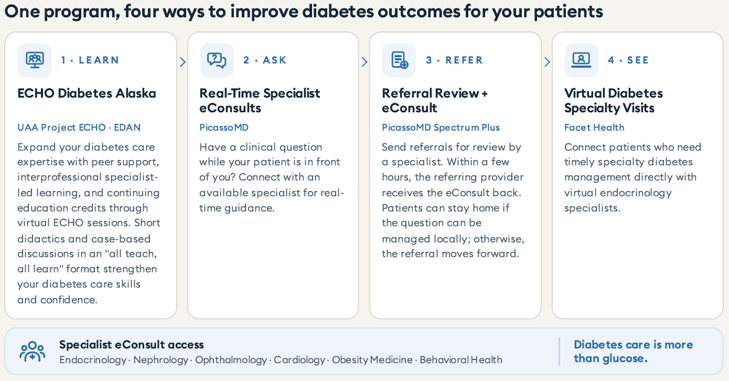
EDAN has received support through the Alaska Rural Health Transformation Program to create the Alaska Rural Diabetes Access and Care Transformation Initiative, a statewide effort designed to expand diabetes care access and strengthen local clinical expertise across Alaska. In collaboration with UAA Center for Human Development, Project ECHO®, Center for Health Care Strategies, PicassoMD, and Facet Health, EDAN will connect primary care clinicians and healthcare teams with peer support, interprofessional specialist-led learning, eConsults, and virtual specialty care. By bringing together clinicians and care teams from practices across Alaska—including rural, frontier, tribal, community health, and critical access settings—the initiative will help strengthen diabetes care and enable more patients to receive care closer to home. The initiative will be provided at no cost to participating sites, helping communities build local diabetes care capacity and strengthen access to specialty expertise statewide.

Alaska, the largest state in the U.S., has fewer than 10 endocrinologists. In 2024, diagnosed diabetes prevalence in Alaskan communities ranged from a low of 7.3% to a high of 13.5%, averaging 8.9% in metro areas and 9.5% in nonmetro areas, making diabetes one of Alaksa’s most pressing health challenges. Across the state, thousands of Alaskans—particularly in rural communities and Alaska Native populations—are living with diabetes or at high risk of developing it. Yet many face barriers that make it difficult to receive the care they need:
Distance & Isolation: People living with diabetes in remote communities may travel hours or fly to access a specialist. Primary care clinicians in these areas often work alone, without easy access to diabetes experts for consultation.
Limited Local Expertise: Rural Alaska has fewer endocrinologists and diabetes educators per capita than urban centers. Many primary care clinicians—who are on the front lines of diabetes care—feel under-supported in managing complex cases, newer medications, and preventive screening.
Serving Alaska's Most Affected Communities: Alaska Native populations and rural communities experience higher rates of diabetes and related health complications. Distance and isolation mean fewer local resources for education, medication management, and preventive care. By training and supporting clinicians where these communities live, we address where the need is greatest.
Preventable Complications: Without timely screening, education, and appropriate management, diabetes complications—kidney disease, vision loss, amputation, cardiovascular events—strain patients, families, and our healthcare system.
The core issue: Many Alaskans with diabetes—or at risk of developing it—cannot access the education, screening, and specialist guidance they need where they live. This means delayed diagnosis, worse outcomes, and unnecessary suffering.
WHY THE ALASKA RURAL DIABETES ACCESS INITIATIVE IS NEEDED NOW
Primary care clinicians are the trusted healthcare professionals in rural communities. When they have the right training, tools, and support, they can deliver high-quality diabetes care locally—without requiring patients to travel.
The Evidence:
Research consistently shows that:
Training Works: When primary care clinicians receive evidence-based diabetes education and access to specialist consultation, they confidently manage more patients, improve medication selection, and increase screening rates in their communities.
Local Care Reduces Burden: Patients who receive diabetes care in their communities are more likely to:
Attend appointments (no travel required)
Remain engaged in treatment
Achieve better health outcomes (improved blood sugar control, fewer complications)
Report higher satisfaction with their care
Local Peer Support + Telehealth = Better Care: When rural clinicians can consult with their peers and with diabetes specialists via Project ECHO® sessions and e-consults—backed by training and protocols—patients get specialist-level guidance without leaving home and local expertise is built. This is especially powerful for Alaska's geography.
Upstream Prevention Matters: Better diabetes screening and early management in primary care prevents costly complications and hospitalizations downstream—benefiting patients and healthcare systems alike.
Our Approach:
This program funds training and support for primary care clinicians across Alaska so they can:
Confidently screen for and diagnose diabetes
Manage common diabetes medications (and stay current with newer therapies)
Provide or coordinate evidence-based patient education
Consult with specialists when needed (via peer networks and e-consults)
Address the unique needs of Alaska Native communities and rural populations
The result: Alaskans living with diabetes—and those at risk—get access to quality care in their communities, led by clinicians they know and trust.
WHAT DOES THE ALSKA RURA DIABETES ACCESS INITIATIVE OFFER?
Join a statewide community of clinicians and health professionals from practices across Alaska working to improve diabetes care. Build local expertise, share best practices, and connect directly with specialists through ECHO, eConsults, and virtual specialty care, all at no cost to participating sites.
WHO CAN JOIN?
Clinicians and health professionals at practices across Alaska – no prior diabetes specialization required
CLINICIANS & CARE TEAMS
Primary care clinicians (MD, DO, NP, PA)
Nurses, care managers, and other care team members
ORGANIZATIONS
PCP practices and groups
FQHCs and health centers
Tribal health organizations
Critical access hospitals
Village and community clinics
Primary care associations
COST?
No cost to participating sites
Every component of the initiative is provided free of charge through Alaska RHTP grant funding.
HELP SHAPE DIABETES CARE ACROSS ALASKA
Sign Up or Join a Listening & Information Session
Learn about the initiative, share your community's needs, and help shape diabetes education and specialty support across Alaska.
Mondays, 12:00–1:00 pm AKT October through December 2026
This program is supported by the Centers for Medicare & Medicaid Services (CMS) of the U.S. Department of Health and Human Services (HHS) through a subaward as part of a financial assistance award of $987,787, representing a portion of the total award of $272,174,855.72 made to the State of Alaska Department of Health with 100 percent funded by CMS/HHS. The contents are those of the author(s) and do not necessarily represent the official views of, nor an endorsement, by CMS/HHS, or the U.S. Government.